Introduction
Introducing the Cyber Resilience Act (CRA)
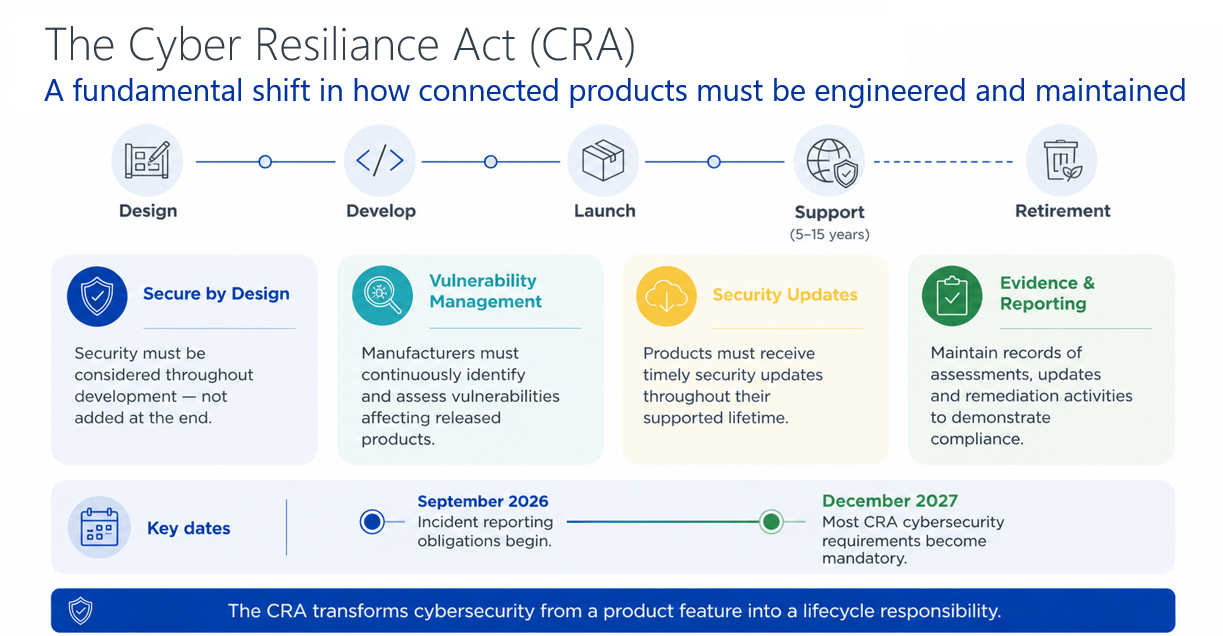
The EU Cyber Resilience Act (Regulation (EU) 2024/2847) sets cybersecurity requirements for products with digital elements placed on the EU market. Reporting obligations for actively exploited vulnerabilities and severe incidents apply from 11 September 2026. The essential requirements, conformity assessment and CE marking apply in full from 11 December 2027.
The Cyber Resilience Act represents a fundamental change in how cybersecurity is integrated into the design, development and lifecycle management of products with digital elements. Cybersecurity can't be treated as an afterthought; to conform with CRA, products must be secure by design, and security vulnerabilities must be managed rigorously throughout the product's lifecycle.
Nordic provides the complete chip-to-cloud security solution to support compliance readiness, powered by nRF Cloud. Nordic supplies the component-level evidence your conformity work draws on: security advisories and a coordinated vulnerability disclosure process, SBOMs for Nordic software, component-level Declarations of Conformity and supporting technical documentation. The product-level risk assessment, Declaration of Conformity, CE marking and reporting obligations remain yours. This page sets out what Nordic provides and when. For the regulation itself and your own obligations, start with the European Commission and ENISA.
What Nordic provides
Your obligations under the CRA are yours. What follows is what Nordic provides for each one: the evidence, tooling and commitments that you can draw on. The first row started applying from September 11th, 2026, and the rows below that apply from December 11th, 2027.
|
Your obligation |
What Nordic provides |
| Report actively exploited vulnerabilities and severe incidents in your product (Article 14). This obligation applies from Sep 11, 2026. | Nordic provides security notifications through myNordic and a coordinated vulnerability disclosure channel. |
| Conduct a threat assessment analysis for your product. This and the obligations below apply from Dec 11, 2027. | You must conduct the threat assessment, but Nordic conformity packages may be used as input to the analysis. |
| Implement a secure-by-design flow for your product. |
You must implement the secure-by-design flow for your own product, and according to your own threat assessment analysis. |
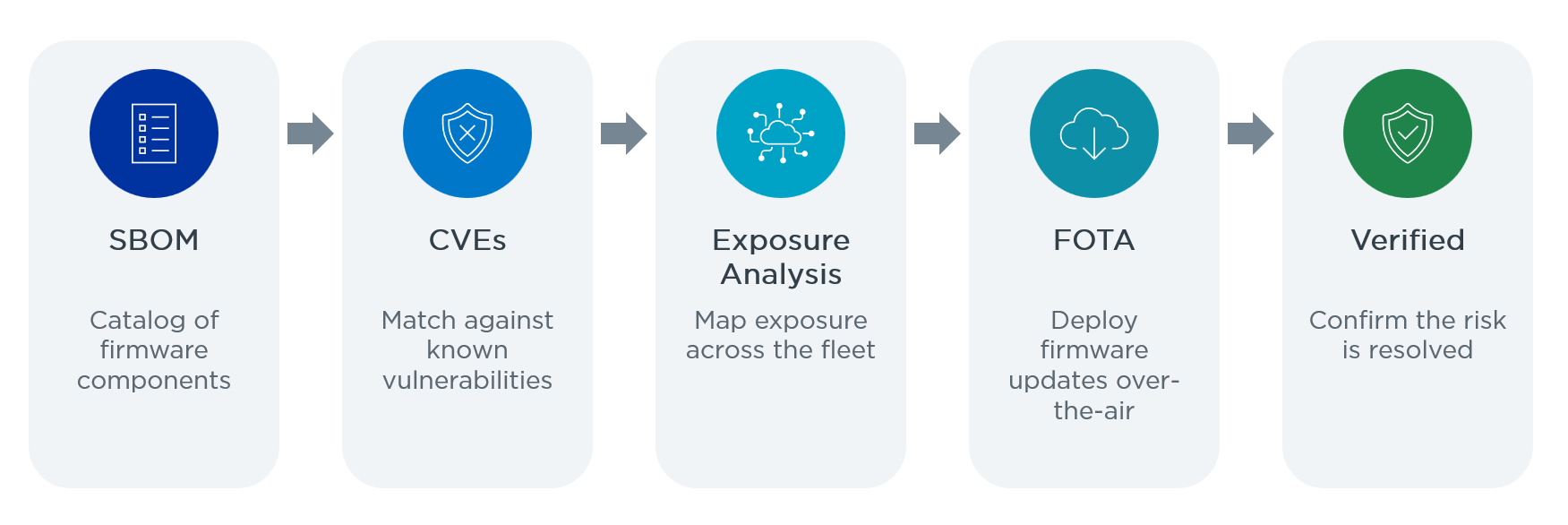
| Implement vulnerability handling and provide security updates for your product in a timely manner as described in Annex I Part II. | Nordic will provide Software Bill-of-Materials (SBOM) generation for Nordic-supplied software, vulnerability fixes under SDK Long-Term Support (LTS), secure firmware-over-the-air (FOTA), and continuous CVE monitoring with fleet exposure analysis through nRF Cloud. |
| Fulfill the essential product security requirements for your product as described in Annex I Part I. | Nordic will provide hardware security features in Nordic silicon, secure-by-design and secure-by-default firmware, and the named SDK version cited in Nordic's conformity documentation. |
| Provide technical documentation and Declaration of Conformity for your product as described in Article 31 and Annex VII. | Nordic will provide component-level Declaration of Conformity and supporting technical evidence for Nordic-supplied components, per conformity package. |
| Declare a support period for your product as described in Article 13(8). | Nordic provides a minimum five-year support commitment on nRF Connect SDK LTS. Further details and information on each software and hardware combination will be published separately. |
| Satisfy the due diligence requirements on integrated components as described in Article 13(5). | Nordic provides a product classification reference, SBOM, and upstream handling of open-source components in nRF Connect SDK. |
Vulnerability handling and disclosure
Reporting obligations started applying from 11 September 2026, which makes this the part that changes something first. Nordic's vulnerability reporting and coordinated disclosure process is in place and can be found here.
- Report a vulnerability in Nordic silicon or Nordic software. Nordic acknowledges receipt, triages, and issues an advisory with mitigation guidance where on is warranted.
- Subscribe to security notifications in myNordic to be told when Nordic publishes a security advisory, rather than having to check for one. Significant items are also carried in Product Update Notifications.
Nordic reports for the products Nordic places on the market. You report for the product you place on the market, including when the root cause sits in a Nordic component. Telling Nordic does not discharge your own reporting obligations.
Nordic notifies actively exploited vulnerabilities and severe security incidents affecting its products to the CSIRT designated as coordinator and to ENISA simultaneously, through ENISA's Single Reporting Platform (SRP), following the regulation's 24-hour, 72-hour and final-report timelines. In parallel, Nordic informs affected customers through myNordic, together with available corrective or mitigating measures.
As our customer, you should create a myNordic account and subscribe to relevant product notifications to start receiving security advisories via email and the myNordic portal.
Product classification
The CRA process starts by classifying your product. Determining your class is your responsibility, and it should be one of the first steps on your path to CRA compliance to determine whether a third-party assessment is required.
There are four classes in CRA, with increasing implications to both security and conformity assessment routes: Default, Important Class I, Important Class II and Critical. The same essential cybersecurity requirements apply for each class, but the Default class is subject to self-assessment only, meaning that a notified body does not need to be involved in the assessment. Class I products may also be subject to self-assessment, if applying a harmonized standard, but otherwise they require a third-party assessment. Products that fall under Class II and Critical are always subject to a third-party assessment or a cybersecure certification.
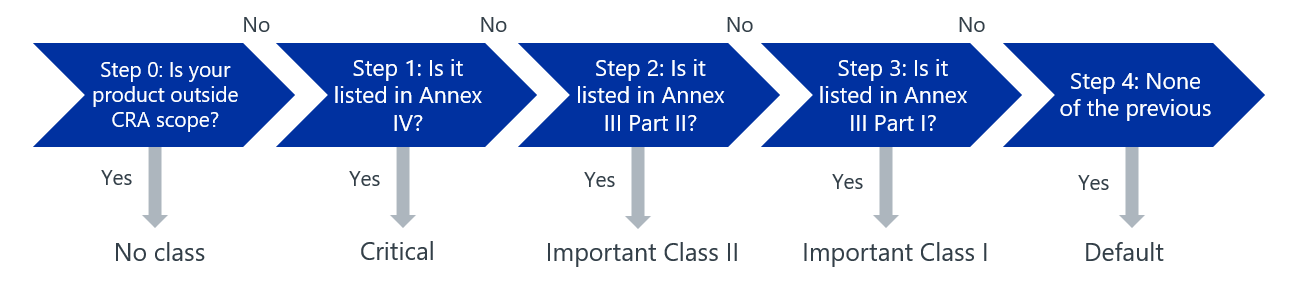
The recommended way to walk through the classification procedure goes as follows. First determine whether your product is in scope of CRA. If yes, determine whether it is a Critical class product as defined in CRA Annex IV. If not, go through the lists of products in CRA Annex III to determine whether your product falls under Class II. If it does not, then determine whether it falls under Class I. If it does not, it falls under the Default class.
The class of a Nordic part does not transfer to your product. A Class I microcontroller inside a smart thermostat does not make the thermostat Class I. Your product is classified on what your product is and does, against the Annex III and Annex IV lists, judged on intended purpose and core functionality rather than on components. Determining your class is yours to do as manufacturer; Nordic will not make the determination for you. The classification reference sets out the decision procedure and the full category list.
In many cases, an IoT end product will fall under the Default class, which means it will be subject to self-assessment instead of assessment by a third party – even if the integrated Nordic part were Class I or Class II. Read through the Annexes III and IV to determine the correct class for your product.
nRF Cloud
Chip-to-cloud security and CRA readiness with Nordic and nRF Cloud
CRA readiness assessment.
Evaluate your connected product against key CRA requirements and cybersecurity best practices. Get a clear readiness score and actionable recommendations. The assessment can be taken here.
Continuous vulnerability monitoring. Monitor CVEs affecting the software running on your products. Go beyond SBOM matching with fleet exposure analysis that identifies which deployed devices are actually affected. Get started with continuous vulnerability monitoring.
Lifetime FOTA. Securely deliver firmware updates throughout the device lifecycle. Track deployment history and verify remediation across affected devices, providing valuable evidence for your technical documentation. Learn more about Lifetime FOTA with nRF Cloud here.
Long-term support and vulnerability maintenance
Nordic places both hardware and software products on the market: for example, a Nordic SoC, such as the nRF52840, with software provided by a Nordic SDK, e.g., nRF Connect SDK v3.4 LTS. Each Nordic SoC has a support period of at least five years from the date the unit is placed on the market. In other words, the hardware will be supported for at least five years after the hardware is shipped. During this period, Nordic will make security updates and vulnerability remediations available to address vulnerabilities affecting the SoC, and where a hardware vulnerability cannot be remediated by an update, Nordic provides mitigations and guidance.
Each SDK version designated for long-term support (such as nRF Connect SDK v3.4 LTS) or vulnerability maintenance has its own minimum 5-year support period. For open-source components that Nordic does not own, Nordic tracks them, applies fixes in the SDK, and reports and shares fixes upstream.
Nordic's support period covers vulnerability handling and security updates for the Nordic product. It is not a commitment to functional maintenance, new features, or silicon supply. Nordic's published lifecycle policy and the applicable Nordic terms, conditions and license terms govern; where this page and those documents differ, those documents prevail.
Where the conformity boundary falls. Nordic declares conformity for the silicon and the named SDK configuration. You declare for the product and place on the market. Nordic's declaration and technical evidence are inputs to your technical file; they do not replace it, and there is no mechanism in the CRA by which a supplier's declaration discharges yours. Your own assessment covers what Nordic's cannot: your application software, your integration and configuration choices, your interfaces and exposed services, and your product's operating environment.
nRF5 SDK vulnerability maintenance
nRF5 SDK is feature-complete, with no further feature development planned. Selected versions of the nRF5 SDK will continue to receive vulnerability maintenance updates, providing security fixes for identified vulnerabilities in the SDK along with machine readable advisories.
In line with our general CRA guidelines stated in the section above, the vulnerability maintenance support period for each selected nRF5 SDK version extends for as long as we continue shipping devices that depend on that version, plus an additional five years. For this purpose, a device depends on an SDK version if it is listed as supported in that version’s release notes, and shipping of a device is considered to end on its last shipment date as published in our product lifecycle information.
The versions designated for vulnerability maintenance are:
- nRF5 SDK v12.3
- nRF5 SDK v15.3
- nRF5 SDK v17.1
If your product is based on another nRF5 SDK version, you need to migrate to one of the supported versions to continue receiving security fixes from Nordic. Meeting your own CRA obligations remains your responsibility.
During the support period, Nordic will monitor for and assess vulnerabilities affecting these specific SDK versions in accordance with Nordic’s vulnerability handling process. Any qualified vulnerability will be remedied if reasonably possible, and fixes will be provided to customers through either SDK updates or patches. One or more maintenance updates may be issued for each supported version before the main CRA obligations start to apply on December 11, 2027.
This information does not change the terms of the nRF5 SDK license and is not a guarantee that your product will comply with the CRA.
FAQ
Frequently asked questions about CRA
Read through these frequently asked questions and answers to get up to speed with CRA and Nordic's security offering.
If you have further questions after reading through the FAQ, please open a DevZone ticket or talk to your local sales representative.
What is considered a product with digital elements?
A product with digital elements is defined as “a software or hardware product and its remote data processing solutions, including software or hardware components being placed on the market separately”. Note that it can be either software, hardware, or a combination of both.
What are the deadlines for CRA?
Mandatory reporting deadline is on September 11th, 2026, and the full compliance deadline is on December 11th, 2027. For further information on the mandatory reporting responsibilities, please refer to the Vulnerability handling and disclosure section at the top of this page.
When does CRA start applying for a product?
CRA starts applying when a product with digital elements is placed on the EU market after December 11th, 2027, and continues to apply throughout its lifetime. For products placed on the market before December 11th, 2027, the CRA applies only if those
products are substantially modified after that date.
This means, a product placed on the market before December 11th, 2027, is not required to be brought into CRA compliance unless it is substantially modified. However, new copies of that product may not be placed on the market after December 11th, 2027, without bringing them to compliance.
Note also that the reporting obligations that came into force on September 11th, 2026, apply also for products placed on the market before that date. For more information, please see the FAQs on the CRA implementation PDF.
How do I receive security advisories for CVEs concerning Nordic products?
Create a myNordic account and subscribe to notifications here. You will then receive security advisories in the email address configured in your myNordic account. You may also additionally subscribe to CVE databases such as NIST's National Vulnerability Database to receive security advisories through those channels as well.
How can I monitor for security vulnerabilities in my firmware?
Set up continuous CVE monitoring using nRF Cloud. Using nRF Cloud allows you to scan your SBOM for known vulnerabilities and monitor risk and resolutions real-time. nRF Cloud's continuous CVE monitoring surfaces new vulnerabilities as they are identified, and existing vulnerability remediations can be triaged and tracked as they roll out. Get fleet-wide visibility into your security and see which devices are exposed or running unpatched firmware across your entire fleet.
How can I provide security updates for my devices in the field?
CRA mandates that you need to be able to provide security updates to your devices in order to patch security vulnerabilities in affected devices. It does not take stance on the exact mechanism – as long as it is secure. The best way to update a wireless device in the field is a firmware over-the-air update, which you can easily set up for a fleet of devices using nRF Cloud. nRF Cloud offers lifetime FOTA, which helps manufacturers deliver security updates over the full lifetime of their devices with predictable commercial terms and a ready-to-use cloud service.
Which SDK version should I use to guarantee I get the latest security updates for my device?
Using the latest nRF Connect SDK LTS version available is recommended for getting the latest security updates. If you are using nRF5 SDK, please refer to the section nRF5 SDK vulnerability maintenance found above on this page.
Does Nordic provide a software bill-of-materials (SBOM) for my application?
Nordic provides a mechanism for you to generate an SBOM for the exact software composition for your application created with nRF Connect SDK. Nordic cannot pre-generate an accurate SBOM for your application, as the components you include in your application dictate what software and versions are found inside. For information on SBOM generation, please refer to the SBOM documentation.
Does the conformance of a Nordic product carry over to my product when it is integrated as a component?
No, the conformance of an integrated component, such as that of a Nordic wireless SoC, does not automatically carry over to the final product. Each manufacturer of a product with digital elements must go through the conformance assessment for their own product.
What does transfer is evidence: A CRA-conformant component can be used as supporting evidence in the integrator's risk assessment and conformity assessment. Conformity (or presumed conformity) of a component may help show that certain requirements are satisfied for that component. However, once components are integrated, new risks can emerge and those risks must be assessed for the finished product.
What is a conformity package?
A conformity package, or the technical documentation or conformity assessment file, under the CRA is the collection of mandatory documents and evidence a manufacturer must compile to prove a hardware, or software product meets the law's essential cybersecurity requirements before it can be sold in the European Union. Nordic will provide conformity packages for Nordic products, which are a combination of software and hardware.
Do Nordic's conformity packages cover my product for CRA?
Nordic's conformity packages fully cover only Nordic products, but they can be used as input and evidence in your technical file for declaring conformity for your products. It is your obligation to ensure CRA conformity for your products.
When will Nordic conformity packages be available?
Nordic's conformity packages will be available in early 2027 as draft versions. The packages will be finalized before December 11th, 2027, but you may already start using the draft versions as soon as they are available. The aim is that the differences between the draft versions and the final versions stay minimal.