Nordic at the heart of micro:bit
Get micro:bits for your classroom
micro:bit class kit program
To mark ten years of micro:bit, we’re sending BBC micro:bit Club kits to classrooms around the world, each with ten micro:bit V2 boards and everything needed to use them.
Nordic silicon has powered every micro:bit since 2016
Nordic Semiconductor is a founding technical partner of the BBC micro:bit, and supplied the first one million SoCs behind the original micro:bit device. Every micro:bit built since runs the child's code, the wireless connection, and the board's sensors on Nordic silicon.
Since 2016, 73.5 million children in more than 85 countries have learned using a micro:bit.
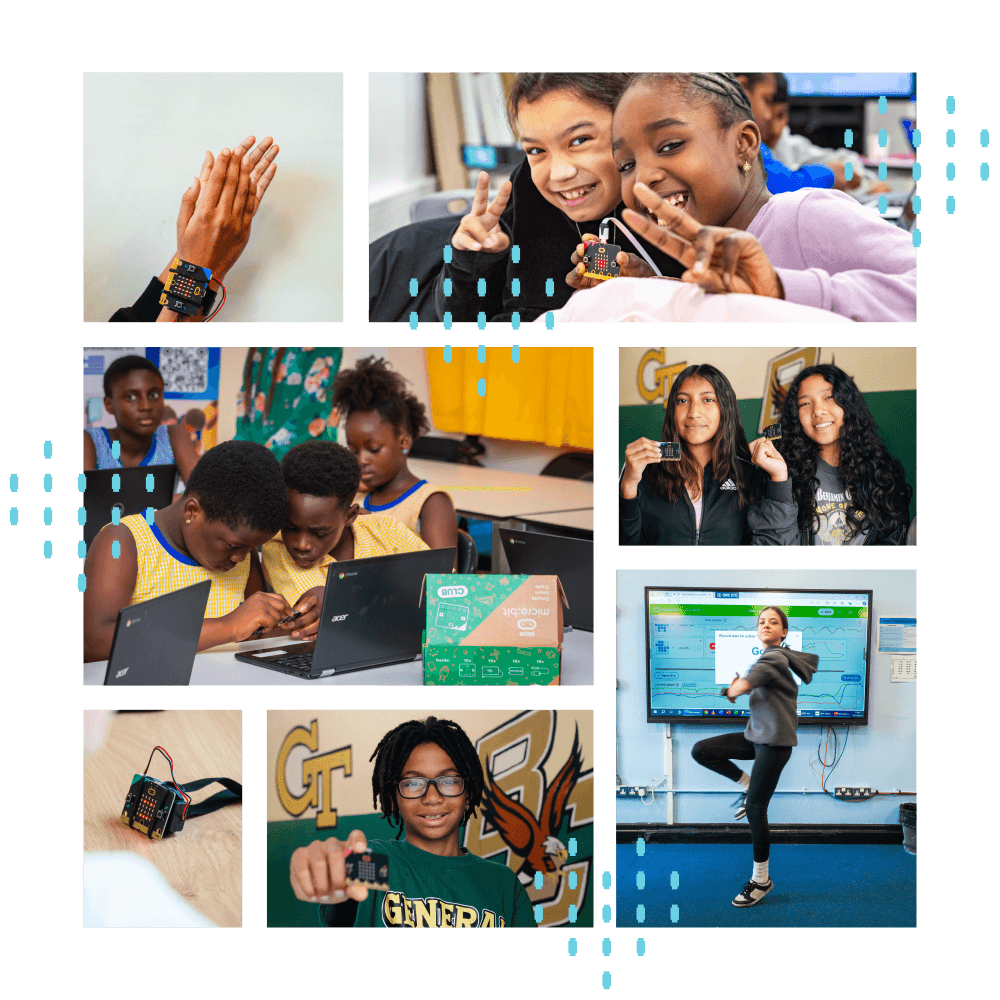
micro:bit in classrooms around the world
The original project covered one country and one school year: every year 7 pupil in the UK. Since then micro:bit has become a fixture in classrooms worldwide, with national and regional programs running in Denmark, Norway, Singapore, Uruguay, Canada, Finland, Japan, and Colombia among others. Teachers use it to introduce coding, physical computing, and now machine learning, often as a pupil's first encounter with hardware they can program themselves.
What is a micro:bit?
The micro:bit is a programmable pocket computer built to teach children to code. The board carries a 25-LED display, buttons, motion and light sensors, a microphone and speaker on the V2, edge connector pins for external hardware, and a Bluetooth LE radio. Children program it in block-based code, Python, or JavaScript, then run their own software directly on the board.
What chip is in the micro:bit?
The original 2016 micro:bit uses the Nordic nRF51822, a Bluetooth LE SoC with a 16 MHz Arm Cortex-M0 processor. Code written by the child runs on that processor alongside the Bluetooth LE stack and the board's sensors and I/O.
The micro:bit V2, released in 2020, uses the Nordic nRF52833. Its 64 MHz Arm Cortex-M4F adds a floating point unit, DSP instructions, 512 KB of flash, and 128 KB of RAM, which is what gives the V2 room to run machine learning models on the board itself.
Why did the BBC choose a Nordic chip?
When the BBC put out its call for commercial partners at the end of 2014, it needed a board cheap enough to give to a million children, simple enough for an eleven year old to program, and interesting within the first minute. Wireless designs of the period typically paired a separate microcontroller with a radio, which meant two chips, more board space, more cost, and RF engineering work the project could not absorb.
The nRF51822 combined the radio and an Arm Cortex-M0 in a single part. Howard Baker, who led the project at BBC Learning, has said the team knew the hardware was solved as soon as Nordic offered a Bluetooth LE SoC with an embedded Arm processor.
Bluetooth LE on the micro:bit
The Nordic SoC gives every micro:bit a Bluetooth LE radio, so boards talk to each other, to phones and tablets, and to computers. Children pair a micro:bit with a phone, send a program to it wirelessly, and control the board or let the board control the phone. The same radio carries the Foundation's own radio protocol for board-to-board messaging.
Can a micro:bit run machine learning?
Yes. The Foundation's CreateAI tool lets a student record examples of a movement with the accelerometer, train a model in the browser, and run it on the board, where it updates its prediction several times a second.
Inference runs on the nRF52833's Cortex-M4F, and the floating point unit and DSP instructions are what make it work inside 128 KB of RAM. CreateAI works with movement data. A micro:bit does not run computer vision or generative models.
The partnership so far
2016
Nordic supplies the first one million nRF51822 SoCs. The BBC gives a free micro:bit to every year 7 pupil in the UK.
2019
100,000 micro:bits reach Norwegian pupils through super:bit.
2020
micro:bit V2 launches with the Nordic nRF52833, adding processing headroom, a microphone, and a speaker.
2024
The micro:bit Educational Foundation launches micro:bit CreateAI. Distribution passes 10 million devices worldwide.
2026
Celebrating 10 years. 73.5 million children in 85+ countries have learned coding using a micro:bit.
Where to go next
Build with the same silicon
nRF Connect SDK is Nordic's software development kit for Bluetooth LE, Wi-Fi, cellular IoT, Thread, and Matter, and micro:bit V2 has been supported since version 1.9.0. Nordic DevAcademy runs free, self-paced courses starting from the fundamentals, and DevZone is where Nordic engineers and the developer community work through problems together.
Get a micro:bit, or teach with one
The micro:bit Educational Foundation sells the device and publishes classroom resources, lesson plans, and teacher training.
Planning an education project?
Nordic works with education partners building programmable hardware for classrooms and universities.